
Why Ikigai Belongs at the Heart of Every School
“Only he who keeps his eye fixed on the far horizon will find the right road.”
— Dag Hammarskjöld
A Question Worth Asking
What if the most important question we could ask a student isn’t “What do you want to
be when you grow up?” but rather “What makes you come alive?”
After nearly four decades working in and around schools—as a teacher, administrator,
district leader, and now superintendent—I’ve watched the first question lead students
toward a kind of performance anxiety, a race toward a credential or a career title that
may or may not ever feel like theirs. The second question opens something different. It
opens a conversation about meaning.
That’s what this series is about.
Welcome to Inspiring Ikigai—a weekly exploration of what it looks like when schools,
educators, families, and communities come together to help students find and live their
deepest purpose. Each week, I’ll draw on my own experience, the wisdom of
extraordinary colleagues, and lessons learned from education systems around the
world—most notably from Finland, where I traveled as a Fulbright Scholar and where
the question of student wellbeing is treated as seriously as any test score.
What Is Ikigai, and Why Does It Matter in Schools?
Ikigai (pronounced ee-key-guy) is a Japanese concept that translates roughly as “reason for being.”
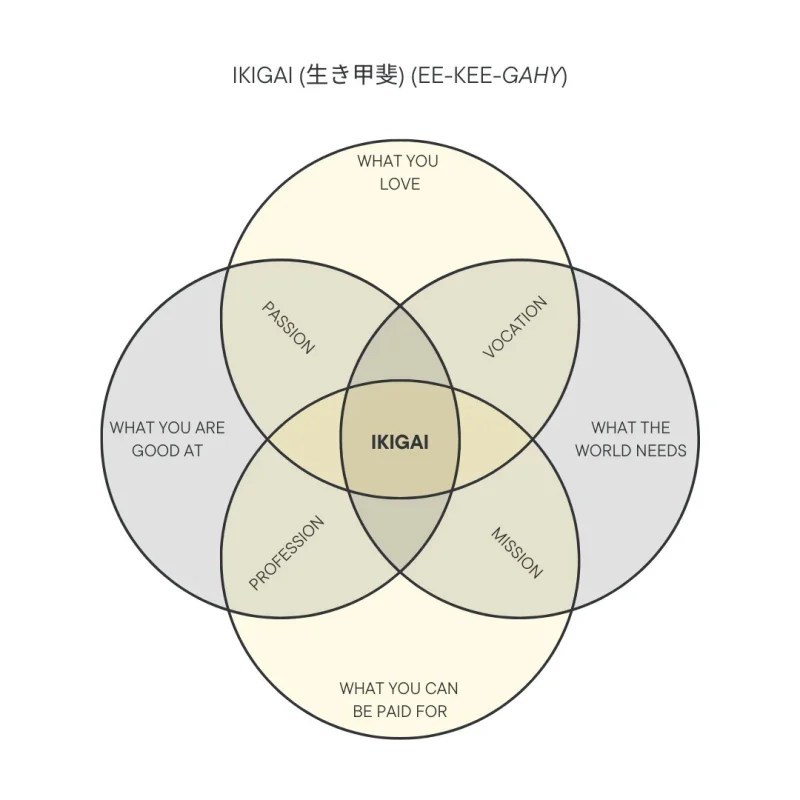
It sits at the intersection of four powerful forces:
- What you love: The things that make you lose track of time, that you would do
simply because they matter to you. - What you’re good at: Your natural gifts, your practiced skills, the ways you
contribute something distinct to the world. - What the world needs: The problems, the gaps, the human needs that call out
for people willing to care and act. - What you can be valued for: The ways your contributions connect to a
livelihood, a community role, a sustainable future.
When a person finds the place where all four overlap, they experience ikigai—a sense of being fully alive in their work and in their relationships. They don’t just tolerate Monday. They look forward to it.
Now ask yourself: How many of the students in your school are moving toward that kind of life? How many of them even know it’s possible?
“The goal of education is not the transmission of knowledge—it
is the cultivation of a human being who can find and
contribute their best self to the world.” — Dr. Karen Cheser
The Crisis of Disconnection
We are graduating students from our schools every spring who, by almost every
measurable standard, have succeeded. They have grades, diplomas, test scores, and
college acceptances. And yet, across the country and around the world, we are watching an epidemic of purposelessness unfold in young people.
Youth mental health is in crisis. Rates of anxiety, depression, and disengagement have
climbed steadily for over a decade. Research consistently tells us that one of the most
powerful protective factors against these outcomes isn’t a higher GPA or a more rigorous curriculum—it’s a sense of meaning. Young people who feel that their life has purpose, that they matter, that their unique gifts are needed—those students are more resilient, more engaged, and more likely to lead healthy and contributing lives.
And yet, much of what we ask students to do in school has been stripped of meaning.
We’ve traded depth for coverage, curiosity for compliance, and voice for quiet
compliance. We sort students into tracks and categories before they’ve had a chance to
discover what they’re truly capable of.
I know what it looks like to be in a community that has fallen into this pattern, and I know what it looks like to fight our way out of it. In Durango, our district has moved to the top 10% of school districts in Colorado (in ELA and math proficiency ). That transformation didn’t happen because we doubled down on test prep. It happened because we asked harder questions—about who our students are, what they need, and what kind of future we are actually preparing them for.
What Ikigai-Inspired Education Actually Looks Like
Let me be clear about something from the start: Inspiring Ikigai is not a
program. It is not a checklist. It is not an acronym that gets added to a
strategic plan and promptly forgotten.
It is a orientation—a fundamental shift in how educators see students, design learning,
and measure what matters. Here are five practices that define ikigai-inspired schools,
each of which we’ll explore in depth throughout this series:
- They Know Their Students as Whole People
In schools where ikigai is alive, teachers know what their students love—not just what
they struggle with academically. They know which student wants to design video games
and which one wants to heal animals. They know who stays up late writing music and
who volunteers every weekend at the food pantry. This knowledge isn’t incidental to
teaching. It is teaching.
Our Portrait of a Graduate framework in Durango was built on this principle. Rather
than defining student success by a narrow set of academic outcomes, we asked: what does a flourishing human being look like? What competencies—empathy, resilience, creativity, agility, communication, courage—do students need not just for careers but for lives? - They Design for Discovery, Not Just Delivery
The Finnish educators I studied alongside during my Fulbright experience had a phrase they used often: slow education. Not slow in the sense of lowered standards—Finland consistently ranks among the world’s top-performing education systems. Slow in the sense of deliberate. Of giving children time and space to wonder, to make connections, to follow threads of curiosity before being tested on them.
Ikigai cannot be discovered on a schedule. But schools can create conditions where
discovery is more likely: interdisciplinary projects that connect to real community
needs, voice and choice in how students demonstrate learning, mentors and internships that bring the adult world into relationship with student questions. - They Connect Learning to Contribution
One of the most powerful shifts an educator can make is to ask, not “Is this student
learning?” but “Is this student contributing?” Ikigai lives in the space where personal
passion meets community need. Schools that take this seriously build partnerships with local businesses, tribal communities, nonprofits, government agencies, hospitals, and farms—so that students can bring their gifts to real problems.
In Durango, we serve a large rural region that includes multiple diverse communities. Our students don’t just learn about these communities—they work alongside them. That experience changes what school means. - They Celebrate What Students Can Do, Not Just What They Know
Competency-based portfolios, exhibitions of learning, student-led conferences, maker exhibitions—these are not just alternative assessment strategies. They are invitations for students to stand up and say: here is what I made. Here is what I solved. Here is what I believe. That act of claiming authorship over one’s own learning is itself an experience of ikigai. - They Involve the Whole Community
Schools cannot do this work alone. The village proverb is worn out from overuse but it is still true: raising a child toward their best self requires more than any single institution can provide. Ikigai-inspired communities create mentorship pathways, apprenticeship experiences, community libraries of expertise, and cultural celebrations that say to young people: you belong here, your gifts are needed here, this place is yours.
Why This Matters for Our Future, Not Just Theirs
I want to close this opening post with a claim I will return to often throughout this
series:
The problems facing our world—climate change, social fragmentation, technological disruption, global health, democratic erosion—will not be solved by people who merely completed a curriculum. They will be solved by people who found their ikigai.
We need engineers who are driven by love for the natural world. We need teachers who
are on fire with curiosity. We need doctors who want to heal not just bodies but systems.
We need artists who make us see what we have been avoiding. We need leaders who lead from conviction rather than convenience.
We cannot build that world by accident. We build it—one student, one classroom, one
community at a time—by being intentional about helping young people discover who
they are and why that matters.
That work is difficult. It is slower than covering standards. It requires trust, creativity,
and courage from educators and communities. It requires us to be honest about the
ways our systems currently work against meaning rather than for it.
But I have seen it work. I have watched students who were invisible in traditional school
settings become remarkable young people when someone finally asked them the right
question. I have watched communities transformed by the energy of young people who
believed their contributions mattered.
That is why we are here.
Coming Up in Inspiring Ikigai
Each week, we’ll go deeper into one dimension of this work. Coming soon:
- Week 2: Designing for Discovery — How to Create Classrooms Where Curiosity Lives
- Week 3: The Portrait of a Graduate — Redefining What Success Looks Like
- Week 4: Community as Curriculum — Bringing the World Into School
- Week 5: From Finland to Durango — What the World’s Best Education Systems Teach Us About Purpose
- Week 6: The Educator’s Ikigai — You Cannot Inspire What You Have Not Found

 Inspiring Ikigai
Leave a comment