Imagine two students, both graduating in June.
The first has a 4.0 GPA, a clean transcript, and near-perfect test scores. He has mastered the game of school. He knows how to study for the test, absorb the rubric, and deliver what each teacher wants. Ask him what he loves, what drives him, what he hopes to contribute to the world — and he will pause longer than you might expect.
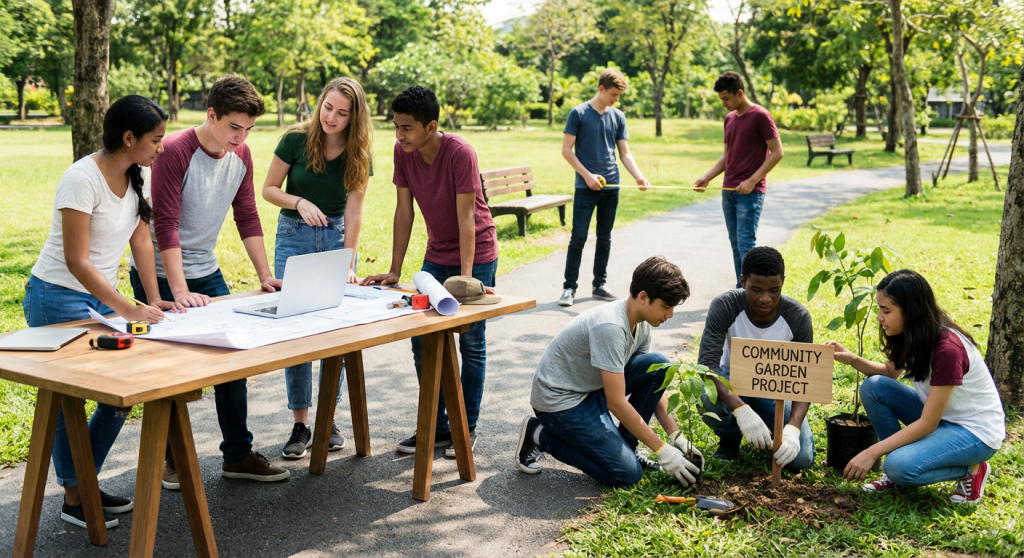
The second has a 3.1 GPA. She has stumbled through chemistry and still wrestles with calculus. But she has also co-led a community health initiative that brought together three agencies and served over 200 families. She can walk into a room of strangers, listen deeply, build trust quickly, and move people toward a shared goal. She knows — with quiet certainty — exactly who she is and what she is here to do.
Which student is more prepared for life?
For most of the twentieth century, schools answered that question with transcripts and test scores. Grades were the proxy for potential. The credential was the goal. But something has shifted — in the economy, in communities, in research on human flourishing — and forward-thinking districts across the country are building a different answer. They are building it through something called the Portrait of a Graduate.
What Is a Portrait of a Graduate?
A Portrait of a Graduate (PoG) is a community-defined vision of what young people need to know, be, and be able to do to thrive in an uncertain, rapidly changing world. It is not a new set of standards. It is not another mandate layered on top of content requirements. It is something more fundamental: a declaration of purpose.
The best Portraits are not written by administrators behind closed doors. They emerge from deep, authentic engagement with an entire community — students, families, teachers, employers, tribal elders, nonprofit leaders, recent graduates, and everyone else with a stake in young people’s futures. At the Durango School District, our Portrait was developed in conversation with over 10,000 stakeholders. That process took time. It required real listening. And it produced something that felt less like a policy document and more like a shared dream.
| Our Portrait of a Graduate centers on six competencies: Empathetic Collaborator, Resilient Risk-Taker, Creative Problem-Solver, Agile Thinker, Confident Communicator, and Courageous Leader. These are not soft skills. They are the capacities that research, employers, and communities consistently identify as most predictive of meaningful contribution — and most underserved by traditional schooling. |
Every word in those six descriptors was chosen with care. We do not just want collaborators — we want empathetic ones, people who can truly see another human being. We do not just want thinkers — we want agile ones, people who can hold ambiguity and pivot when the world changes. We do not just want risk-takers — we want resilient ones, people who fail, learn, and keep going.
The Connection to Ikigai
If ikigai is the sweet spot where what you love, what you are good at, what the world needs, and what you can be paid for all converge — then a Portrait of a Graduate is, in many ways, the educational architecture that makes that convergence possible.
Think about it this way:
- When we develop Empathetic Collaborators, we are helping students become better attuned to what the world needs.
- When we cultivate Creative Problem-Solvers and Agile Thinkers, we are expanding the range of what students are good at.
- When we nurture Courageous Leaders and Confident Communicators, we are giving students the voice to pursue what they love.
- And when we build Resilient Risk-Takers, we are preparing them for the real-world terrain between dreaming and doing.
A diploma that certifies content mastery is a floor. A Portrait of a Graduate is an invitation to the ceiling — and everything in between.
I think often about the Finnish concept of sisu — a kind of fierce, quiet courage in the face of hardship — which I encountered during my Fulbright study of Finnish education. In Finland, there is a deep cultural understanding that education exists not to produce workers, but to develop whole, dignified human beings. The Portrait of a Graduate framework carries that same conviction. School is not preparation for life. School is life — and it should honor the full, complex, purposeful humanity of every child within it.
Six Competencies, Six Pathways to Ikigai
Let me show you what each PoG competency looks like when it is working — and how it opens a door toward a student’s unique ikigai.
| Competency | Connection to Ikigai |
| 🤝 Empathetic Collaborator | Teaches students to listen before leading — a prerequisite for understanding what the world truly needs. |
| 🌱 Resilient Risk-Taker | Builds the courage to pursue what you love, even when the path is uncertain. |
| 💡 Creative Problem-Solver | Expands what students believe they are capable of — the “what you are good at” quadrant, reimagined. |
| 🔄 Agile Thinker | Cultivates intellectual flexibility, helping students find purpose even as the world shifts beneath them. |
| 🗣️ Confident Communicator | Gives students the voice to articulate their vision, attract collaborators, and pursue meaningful work. |
| 🦁 Courageous Leader | Moves ikigai from private aspiration to public contribution — from who I am to what I will do about it. |
What Changes When We Lead with a Portrait
Adopting a Portrait of a Graduate is not a curriculum decision. It is a cultural one. When a school community truly commits to a Portrait, several shifts begin to happen — not overnight, but steadily, unmistakably.
Assessment expands.
Instead of asking only, “What can this student recall?” we begin asking “What can this student do, and who is this student becoming?” Capstone projects, student-led exhibitions, and community-connected demonstrations of learning start to carry real weight alongside traditional assessments.
Teacher identity shifts.
When teachers know that their job is to develop Courageous Leaders and Resilient Risk-Takers — not just cover standards — something opens up in how they design learning experiences. The Portrait becomes what I call planning permission: explicit community authorization to prioritize depth, agency, and purpose alongside content.
Students gain language for who they are.
One of the most powerful things that happens when students grow up in a PoG culture is that they develop vocabulary for their own identity. I have sat across from eighth graders who can say, with genuine insight, “I think I am a stronger Empathetic Collaborator than I am a Creative Problem-Solver right now, but I am working on it.” That level of self-awareness is not automatic. It is cultivated — deliberately, over years, by educators who believe it matters.
| “The diploma certifies what you know. The Portrait of a Graduate certifies who you are becoming — and what you are capable of contributing.” — Dr. Karen Cheser |
A Story From the Hallways of Durango School District
Last spring, a junior named Marcus came to talk with me. He was not in academic trouble. He was not seeking a recommendation letter. He simply had a question that had been sitting with him all year.
“Dr. Cheser,” he said, “I know I want to do something with engineering and I know I want to work in my community someday. But I don’t know if that’s actually possible — like, are those things allowed to go together?”
I thought about what had planted that question in him. He had grown up hearing that success meant leaving — going to a big city, a big company, a world far from the Four Corners region. Somewhere along the way, ambition and belonging had come to feel like opposites.
We talked for a long time. I told him about the ICON Workforce Development Center we were building — a regional career and technical education hub with pathways in healthcare, skilled trades, aviation, and entrepreneurship. I told him about the engineers who had grown up here and come back to work on water infrastructure for tribal communities. I told him about ikigai.
By the end of our conversation, his original question had transformed. He was no longer asking whether his loves were allowed to coexist. He was asking how to get started.
That is what a Portrait of a Graduate makes possible. It is not just a framework. It is a mirror — and sometimes, for a student who has never been given the right mirror, it is the most important thing a school can offer.
Building Your Own Portrait: A Starting Point
If your district has not yet developed a Portrait of a Graduate, here is how I would invite you to begin — not with a consultant or a committee, but with a question.
| Ask 10 people in your community — students, graduates, parents, employers, elders — this single question: “When a student walks out of our schools for the last time, what do you hope they carry with them — not just in their head, but in their character?” Then listen. Really listen. The Portrait is already there, living in your community. Your job is to help it surface. This is the start. From there, ask more people, and more people-community leaders, students, teachers and staff, families…. |
From there, look for the patterns. Find the convergence. Build consensus around the qualities that matter most. Then do the harder, longer, more important work of redesigning your schools so that those qualities are not aspirational — they are unavoidable.
Redefining Success, One Student at a Time
Remember the two students from the beginning of this post?
Both of them are real — composites of students I have known and loved over nearly four decades in education. And both of them deserve schools that see them fully.
The student with the 4.0 deserves a school that asks him the hard questions: not just “What do you know?” but “Who are you? What do you care about? What will you do with all of that knowledge when no one is handing you a rubric?”
The student with the 3.1 deserves a school that has the language and the structures to name and honor her gifts — to say, officially and publicly, “This person is an extraordinary Empathetic Collaborator and a Courageous Leader. The world needs her.”
Success is not a GPA. It is not a test score. It is a life that matters — to the person living it and to the community surrounding it. That is what a Portrait of a Graduate is designed to cultivate. And in my deepest conviction, it is the closest thing we have in K–12 education to a roadmap toward ikigai.
Coming Next in the Series
- Week 4: Community as Curriculum — Bringing the World Into School
- Week 5: From Finland to Durango — What the World’s Best Education Systems Teach Us About Purpose
- Week 6: The Educator’s Ikigai — You Cannot Inspire What You Have Not Found





Leave a comment