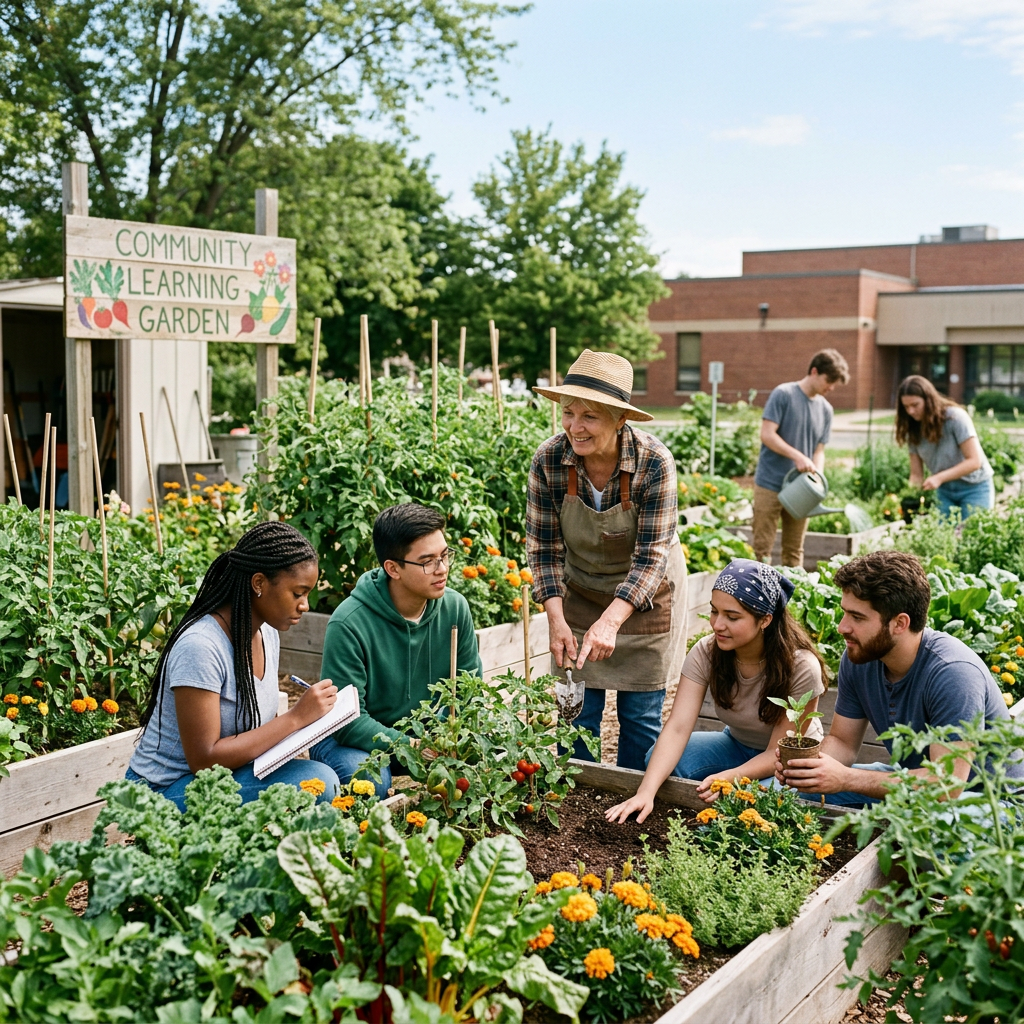
Community as Curriculum
Bringing the World Into School
It is not every school where you might walk down the hallway and hear the soft bleating of a lamb. But at Escalante Middle School, that is not unusual — it is the point.
In our agriculture and veterinary science class, students do not just read about animal biology. They live it. They bottle-feed foster kittens, monitor their weight, track their developmental milestones, and learn the patience and attentiveness that real animal care demands. They raise lambs, study livestock health, and begin to understand — in a way no textbook can replicate — what it means to be responsible for another living creature.
For many of these students, caring for an animal is the first time school has asked something of them that genuinely cannot be faked. You cannot bubble-sheet your way through a kitten’s 2 a.m. feeding schedule. You have to show up, pay attention, and care — truly care — about the outcome. That is the beginning of purpose. That is ikigai taking root.
| The community is not a supplement to the curriculum. It is the curriculum. |
Why Community Is the Missing Ingredient in Most Schools
For too long, the school building has been treated as a container — a place where learning happens in isolation from the messiness, beauty, and complexity of real life. Students rotate through subjects in fifty-minute increments, disconnected from the context that would make the content meaningful. We ask teenagers to solve for x without ever showing them why x matters.
Ikigai offers a different model. At its heart, ikigai is about living at the intersection of what you love, what you’re good at, what the world needs, and what can sustain you. The school’s job is to help students discover all four — and you simply cannot do that from inside four walls.
Community partnerships are not a luxury or a gifted-program enhancement. They are the oxygen of a Portrait of a Graduate education. When we connect students to the world through meaningful, authentic experiences — in every school, at every grade level — we make all six Portrait of a Graduate competencies real:
| Portrait Competency | What Community Engagement Makes Possible |
| Empathetic Collaborator | Listening and working alongside professionals, neighbors, and peers whose lives and challenges differ from their own |
| Resilient Risk-Taker | Presenting ideas, pitching solutions, and navigating real-world feedback from audiences who aren’t their teachers |
| Creative Problem-Solver | Tackling genuine community challenges — from school gardens to Better World Day projects — with no predetermined answer |
| Agile Thinker | Adapting when a project pivots, a community partner shifts direction, or a real-world constraint reshapes the plan |
| Confident Communicator | Speaking, writing, and designing for authentic audiences who will actually use or respond to their work |
| Courageous Leader | Taking responsibility for something that matters beyond the classroom — and living with the real consequences |
What This Looks Like in the Durango School District
Durango is a rural community of roughly 20,000 people in the mountains of southwestern Colorado, bordered by Mesa Verde, the San Juan National Forest, and some of the most spectacular high-desert terrain in the American West. For some, that geography might sound like a limitation. We have chosen to see it as an extraordinary asset — and as a community full of educators, professionals, makers, and innovators who want to be part of what school can be.
Here is how we have made the community our curriculum — from elementary school through graduation:
Better World Day: Elementary Students Who Already Want to Change the World
At Park Elementary School and Riverview Elementary School, students do not wait until they are old enough to “do something real.” Better World Day projects ask students — as young as kindergarten — to identify a problem in their community or world and take meaningful action to address it.
Students have organized food and supply drives, created campaigns for environmental awareness, launched kindness initiatives, and built community resources — all driven by student voice and genuine care for the world beyond the classroom walls.
Better World Day is more than a service learning project. It is an annual reminder that young people already possess the instinct to contribute — they simply need a school willing to trust them with something real. The ikigai question “What does the world need?” is not abstract for these students. They are already answering it.
| Better World Day exemplifies what it means to treat community as curriculum: students are not learning about civic engagement in theory — they are practicing it, at age six, with real stakes and genuine outcomes. |
Project-Based Learning Across All Schools: Authentic Problems, Real Audiences
Project-based learning is not a teaching strategy we reserve for special programs or select classrooms. It is a district-wide instructional approach rooted in the belief that students learn most deeply when they are working on problems that matter — to them, to their community, and to the world.
Across the Durango School District, students design, build, research, argue, present, and create for audiences that extend far beyond their teachers. They pitch solutions to local businesses. They present environmental findings to city stakeholders. They produce work that is meant to be used, not just graded.
When a student knows their project will be seen, used, or evaluated by someone other than their teacher, something shifts. The work becomes real. The standards become personal. The Portrait of a Graduate competencies stop being abstract aspirations and start being lived commitments.
YouScience: Helping Students Know Themselves Before the World Asks
At the middle and high school levels, students engage with YouScience — a research-backed platform that helps them discover their natural aptitudes, explore career pathways, and begin to see themselves in the world of work in a concrete, personalized way.
YouScience does something remarkably aligned with ikigai: it helps students understand not just what they enjoy or what they think they want to do, but what they are naturally wired to do well — and then connects those aptitudes to real career possibilities they might never have discovered on their own.
In a community like Durango, this matters enormously. Students who grow up in rural areas often have narrower exposure to the full range of careers that exist. YouScience opens that aperture — and helps students from every background see that their strengths have a place in the world.
The Ignite Mobile Learning Lab: Opportunity Comes to You
One of the most persistent equity challenges in rural education is geography. For example, The Durango School District covers over 100 square miles (approximately the land mass of Rhode island). Not every student can easily access enrichment programs, makerspaces, or hands-on STEM experiences, especially in the summer. The Ignite Mobile Learning Lab was built to close that gap.
Rolling into schools and communities across the district, the Ignite Mobile Learning Lab brings tools for hands-on STEM exploration, creative making, design thinking, and career-connected learning directly to students — regardless of where they live or what their access to transportation looks like.
| The Ignite Mobile Learning Lab is one of our most intentional commitments to equity — ensuring that community-as-curriculum reaches every student, including students in underserved communities who have historically had the fewest doors opened for them. |
Durango High School and the Impact Career Innovation Center: Industry as a Co-Teacher
At the high school level, students are brought face-to-face with the working world through 14 Career and Technical Education pathways — from healthcare, engineering, and computer science to culinary arts, early childhood education, and building trades. These are not simulations. Students earn industry certifications, work alongside community professionals, and build portfolios that open real doors after graduation.
Work-based learning is embedded throughout — connecting students to internships, job shadows, and career experiences that place them inside the professional world before they leave high school. A student interested in healthcare is not just learning about medicine — they are visiting clinical settings, observing professionals, and beginning to understand whether that path is truly theirs.
This is the intersection of ikigai at its most tangible: what I love, what I’m good at, what the world needs, and what could sustain me — made visible through direct experience with working professionals in a community that wants students to succeed.
Big Picture High School: “Interest-Ships” and Learning on the Student’s Own Terms
Big Picture High School in the Durango School District is built on a model that turns conventional schooling inside out. Rather than asking students to fit themselves into a curriculum, Big Picture asks the curriculum to fit itself around the student.
Twice a week, Big Picture students leave the building entirely and head into the community for what we call “interest-ships” — immersive, interest-driven learning placements with community mentors in fields the student has chosen to explore. Unlike traditional internships, interest-ships are not about filling a role. They are about discovering one.
A student fascinated by architecture spends two days a week in a design studio. A student drawn to environmental advocacy works alongside a nonprofit. A student who has always loved cooking learns the realities of running a professional kitchen. Each of these students is not preparing for their future — they are living it, now, in community.
Big Picture’s interest-ship model is perhaps the most direct expression of community as curriculum that our district offers. The community is not a context for learning — it is the learning.
| “We need to stop treating the community as something students will eventually enter — and start treating it as the environment in which students are already learning to thrive.” |
The Students We Are Serving: Meet Generation Alpha — the Honey Badgers
There is one more dimension of community as curriculum that educators must reckon with directly — and it has everything to do with who is sitting in our classrooms right now.
Today’s K–12 students are Generation Alpha — the first generation born entirely in the 21st century, and the most digitally native, globally connected, socially conscious cohort in the history of formal education. Some researchers have started calling them the “Honey Badgers,” and the name fits: they are tenacious, they don’t back down from complexity, and they are not particularly interested in doing things the way they’ve always been done.
Generation Alpha does not want to wait until they are adults to matter. They are watching the world — its injustices, its possibilities, its climate, its technology, its divisions — and they want to do something about it now. They are not content to learn about problems in the abstract. They want to solve them.
This is not a challenge for educators — it is a gift. These are students who come to school already asking the most important ikigai questions: What needs to change? What can I contribute? What does the world need from me?
Our job is not to manage that energy or redirect it toward compliance. Our job is to channel it — into Better World Day projects, into interest-ships, into work-based learning, into project-based challenges rooted in real community needs — and trust that when we give Generation Alpha students genuine agency over genuine problems, they will show us what they are capable of.
| Generation Alpha will not be satisfied with schools that talk about the future without letting them touch it. Community as curriculum is not just a pedagogical philosophy — it is the response this generation is demanding from every educator willing to listen. |
Five Principles for Building a Community-as-Curriculum Culture
Community partnerships do not materialize on their own. They are built through intention, trust, and persistent relationship-tending. Here are five principles that have guided our work in the Durango School District:
1. Start With Asset Mapping, Not Needs Assessment
Before identifying what your community can give students, identify what your community already has. Every rural, urban, and suburban community is rich with expertise, story, and lived experience. The question is not “what can we get?” but “what do we already have access to that we haven’t yet seen?”
2. Design for Every Student, Not Just the Most Visible Ones
The Ignite Mobile Learning Lab, YouScience, the Impact Center, interest-ships, and Better World Day all share a common design principle: they are built to reach every student. If your community partnerships only reach students who are already advantaged — those enrolled in AP courses, those with involved parents, those in the right zip code — they are not community as curriculum. They are community as privilege.
3. Connect Every Experience to the Portrait of a Graduate
Every community experience should be deliberately connected to your graduate profile competencies. When students know why they’re doing something — when they understand that their interest-ship is building their identity as a Confident Communicator, or that their Better World Day project is developing them as a Courageous Leader — the experience becomes formative rather than incidental.
4. Let Students Lead the Question
The most powerful community experiences in our district are those that begin with student curiosity. YouScience reveals aptitudes students didn’t know they had. Interest-ships follow the student’s genuine interests. Better World Day asks students what they care about. When we lead with student voice, community becomes a place of discovery rather than obligation.
5. Celebrate What Students Produce for Real Audiences
When a student’s project — shaped by community input, motivated by genuine care, executed with real effort — produces something that matters to someone outside the school, share it. Let the community see itself reflected in what students create. This closes the loop, deepens the partnership, and tells the next generation of students: your work is real, and the world is paying attention.
| A Starting Point: Identify one community asset in your district — a profession, a place, a problem, a person — that your students could engage with authentically this semester. Connect it to a Portrait of a Graduate competency and a real audience. Then get out of the way and watch what happens. |
Reflection: The Community Has Always Been the Point
I have spent nearly four decades in education. I have watched school reform come and go in waves — standards-based accountability, 21st century skills, personalized learning, AI integration. Each wave brings new language and new urgency. But the students sitting in our classrooms have not changed in what they most fundamentally need: to feel that their learning matters, that the adults around them believe in their potential, and that the world they are preparing to enter is not some distant abstraction but a real, accessible, interesting place full of people who want them to succeed.
The foster kittens at Escalante Middle School. The Better World Day projects at Park and Riverview Elementaries. The student heading to her interest-ship at an architecture firm two mornings a week. The high school junior earning a healthcare certification. The seventh-grader discovering, through YouScience, that her aptitudes align with a career she’d never considered. The Ignite Mobile Learning Lab parked outside a community that needed it most.
These are not programs. They are a philosophy — made visible, made local, made real.
Generation Alpha did not come to school to be passive recipients of information. They came to change something. Our job — as educators, as community members, as believers in what young people can do — is to give them the tools, the relationships, and the permission to try.
| When students find their ikigai, it will not happen in a lesson. It will happen in a moment of genuine encounter — with a person, a place, a problem, or a possibility that school was generous enough to let in. |
Coming Next in the Series
- Week 5: From Finland to Durango — What the World’s Best Education Systems Teach Us About Purpose
- Week 6: The Educator’s Ikigai — You Cannot Inspire What You Have Not Found





Leave a comment